If you’ve ever woken up with a sore jaw, caught yourself grinding your teeth, or felt a clicking sensation every time you chew, you’re not alone. Jaw pain is one of the most common — and most commonly overlooked — sources of chronic discomfort. And for many people, it’s something they’ve learned to live with because they weren’t sure what to do about it.
At Emerald City Acupuncture, we’ve seen a significant increase in patients coming to us with TMJ disorder and jaw-related pain over the past year. What we’ve found is that many of these patients had no idea that acupuncture was even an option — let alone one supported by a growing body of clinical research. So we decided to write a short blog explaining how we use acupuncture to treat TMJ and jaw pain here in Greenville, NC.
Whether you’ve never tried acupuncture or aren’t even sure what TMJ is, we’re going to walk through everything you need to know: what TMJ disorder actually is, how acupuncture works in the body, what the research says about acupuncture for jaw pain, and what care might realistically look like for you.
First: What Is TMJ Disorder?
TMJ stands for temporomandibular joint — the joint on each side of your head that connects your jaw to your skull. You use this joint constantly: every time you talk, chew, yawn, or swallow. When something goes wrong with this joint or the muscles surrounding it, the result is temporomandibular disorder, commonly referred to as TMJ or TMD.
Symptoms can include:
- Jaw pain or tenderness, especially in the morning
- A clicking, popping, or grating sound when opening or closing the mouth
- Difficulty chewing or a feeling that your bite is “off”
- Aching pain in or around the ear
- Facial pain or tightness
- Headaches, particularly at the temples
- Jaw locking — difficulty opening or closing the mouth fully
- Neck and shoulder tension that seems connected to jaw tightness
What makes TMJ disorder particularly frustrating is how interconnected it is with other systems in the body. Many patients come in believing they have a headache problem, or an ear problem, or a neck problem — and discover that the jaw is the underlying driver of multiple symptoms at once. The muscles and nerves involved in jaw function are deeply connected to the head, neck, and shoulders, which is why TMJ pain rarely stays contained to just the jaw.
What Is Acupuncture, and How Does It Work?
If you’re new to acupuncture, this section is for you.
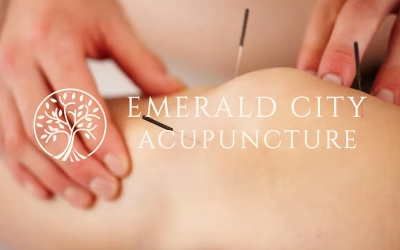
Acupuncture is a practice rooted in Traditional Chinese Medicine with a documented history spanning thousands of years. It involves the insertion of very thin, sterile, single-use needles at specific points on the body — points that have been mapped over centuries and studied extensively in modern clinical research.
From a Western medicine perspective, acupuncture works through several well-documented mechanisms:
Nervous system regulation. Acupuncture stimulates the nervous system in ways that can reduce pain signaling. Needling specific points activates the body’s endogenous opioid system — the same system that produces natural pain-relieving compounds like endorphins — helping to turn down the volume on chronic pain signals.
Muscle tension release. Many of the conditions acupuncture treats most effectively involve muscular dysfunction. Needling can directly target areas of chronic muscle tension, helping tight, overworked muscle groups release and restore normal function.
Circulation and inflammation. Local needling increases blood flow to the treated area, which supports the body’s natural tissue repair processes and helps reduce localized inflammation.
Parasympathetic activation. Acupuncture helps shift the nervous system away from a stress state — often described as “fight or flight” — toward a state of rest and recovery. This is why many patients describe feeling profoundly relaxed during and after treatment, even when they came in for a physical complaint like pain.
It’s worth noting that acupuncture is not a standalone replacement for Western medical care. At Emerald City, we work alongside our patients’ existing healthcare providers — not instead of them. Think of acupuncture as a tool in a broader, whole-person approach to health, one that addresses what other treatments sometimes don’t reach.
What Does the Research Say About Acupuncture for TMJ?
We believe in being honest with our patients about what the evidence shows — including where it’s strong, and where more research is still needed. Here’s what the current literature actually says.
Randomized Clinical Trial — QJMed (2024)
A 2024 randomized clinical trial published in QJMed directly compared acupuncture to sham acupuncture in patients with temporomandibular disorders. The acupuncture group showed significantly reduced pain intensity compared to the sham group at four weeks, providing controlled evidence that the benefits observed were not simply a placebo effect.
Systematic Review and Meta-Analysis — BMC Oral Health (2024)
A 2024 systematic review and meta-analysis published in BMC Oral Health, authored by Di Francesco, Minervini, and colleagues, analyzed randomized controlled trials across PubMed, EMBASE, and SCOPUS databases. Their findings showed that acupuncture is helpful in reducing the severity of TMD pain — particularly pain with muscular origin. For patients whose jaw pain stems primarily from muscle tension and dysfunction (one of the most common presentations), the evidence is particularly supportive.
Systematic Review and Meta-Analysis — Medicine, Baltimore (2023)
A 2023 systematic review and meta-analysis published in Medicine (Baltimore), which searched 11 Korean and international databases to identify acupuncture studies in adults with TMD, found meaningful effects on pain outcomes and assessed acupuncture’s effectiveness and safety profile across randomized clinical trials. Although it is important to note this review also stated that more in depth research was needed as the quality of some studies was low.
What the Research Tells Us — and Where It’s Still Growing
The honest summary: the evidence for acupuncture in TMJ pain management is promising and increasingly well-supported, particularly for muscle-origin pain. Some earlier reviews called for more rigorous studies, and that’s a fair assessment — the research base, while growing, is not as extensive as it is for conditions like chronic low back pain or migraines, where acupuncture has decades of robust clinical data behind it.
What we can say with confidence is that acupuncture is a low-risk, non-invasive option that an increasing body of research supports — and that for many of our own patients, it has been a meaningful part of finding relief.
What We’ve Seen in Our Own Practice Treating TMJ and Jaw Pain with Acupuncture
We want to be clear: every patient is different, progress is not linear, and outcomes are never guaranteed. What we can share is our clinical experience.
Over the past year, we’ve worked with a growing number of patients presenting with TMJ disorder and jaw-related pain. They’ve come in with different symptom profiles, different histories, and different goals. Some had been dealing with jaw pain for years. Others were in the earlier stages.
For many of our patients, consistent acupuncture care has been a meaningful part of working toward symptom management, jaw pain relief, and returning to the daily activities that pain had been disrupting.
Our goal is always the same: understand your full picture, build a plan around it, and work alongside you — consistently and patiently — toward the lifestyle you want. For some, that means coming in every month or two, and for others that might mean having a treatment session every two weeks due to the clenching caused by stress or their work.
Our Holistic Approach to Healthcare: Why It Matters
The conventional medical system is extraordinarily good at many things. But we feel it’s built around treating conditions in relative isolation — you see a specialist for your jaw, a different doctor for your headaches, another for your sleep issues. Each appointment is fifteen minutes; each provider is working from their piece of the puzzle.
What acupuncture offers is a different lens. When a patient comes to us with jaw pain, we’re not just looking at the jaw. We’re asking: How are you sleeping? Where do you carry tension? What’s your stress load like? How do your neck and shoulders feel? Our approach to treating jaw pain is to include the areas around it as well. Our bodies don’t exist in isolation.
This is what “holistic care” actually means in practice. It doesn’t mean ignoring evidence-based medicine. It means building a complete picture of the patient as a person, and treating that picture — not just the symptom that brought them through the door.
What to Expect If You Come to Us for TMJ Treatment
If you’re curious about acupuncture for jaw pain, here’s what the process looks like at Emerald City Acupuncture.
Consultation first, always. Before any treatment begins, you’ll sit down with Mary Elizabeth for a one-on-one consultation. She’ll go through your health history, your symptoms, when and how they showed up, and what you’re hoping to achieve. This conversation isn’t a formality — it’s how she builds a treatment plan that’s specific to you rather than generic to your diagnosis.
A plan built around your life. Treatment frequency and scheduling are built around your symptoms and severity. Healing has to be sustainable to work. For most TMD patients, earlier treatment phases involve more frequent sessions, with the goal of moving toward less frequent maintenance care as symptoms improve.
The whole picture, every time. Your jaw doesn’t get treated in isolation. Every session considers how everything connects — your sleep, your stress, your neck and shoulders, your overall health — because that’s what actually produces lasting results.
An honest conversation about fit. If acupuncture doesn’t seem like the right tool for what you’re dealing with, we’ll tell you that. We’d rather have that conversation early than after several sessions. Your time and your health are too important for anything less.
Is Acupuncture Right for You?
Acupuncture is not for everyone, and we’re not in the business of overselling it. What it is, for the right patient, is a genuinely useful addition to a broader healthcare approach — one that many people don’t know exists as an option until someone tells them.
If you’ve been living with jaw pain, TMJ symptoms, or related headaches and facial tension, and you haven’t explored acupuncture, it may be worth a conversation.
Individual patient experiences and outcomes vary. Results are not guaranteed.
Read the Research
We encourage you to explore the studies we referenced in this post:
- QJMed randomized clinical trial (2024): pubmed.ncbi.nlm.nih.gov/38710498
- BMC Oral Health systematic review and meta-analysis (2024): pubmed.ncbi.nlm.nih.gov/38308258
- Medicine (Baltimore) systematic review and meta-analysis (2023): pubmed.ncbi.nlm.nih.gov/37746950
Ready to Talk?
If you have questions about TMJ, acupuncture, or whether this might be a fit for what you’re dealing with, we’d love to hear from you. You can reach us by phone, through our website, or by texting our office number. Consultations are the first step — and sometimes, that first conversation changes everything.
Emerald City Acupuncture Greenville, NC
This blog post is for educational purposes only and does not constitute medical advice. Please consult a qualified healthcare provider for diagnosis and treatment of any medical condition.